Mark Tabata’s Weekday Devotionals
Monday, October 19 2026
More Bible Studies Available @ http://www.marktabata.com. To Receive Free Bible Studies and updates via email, contact Mark Tabata @ 606-216-1757 (SMS Only) or mailto:markatabata@gmail.com (Email). Follow me on Substack: http://substack.com/@marktabata. Also, please visit my author page: http://amazon.com/author/marktabata
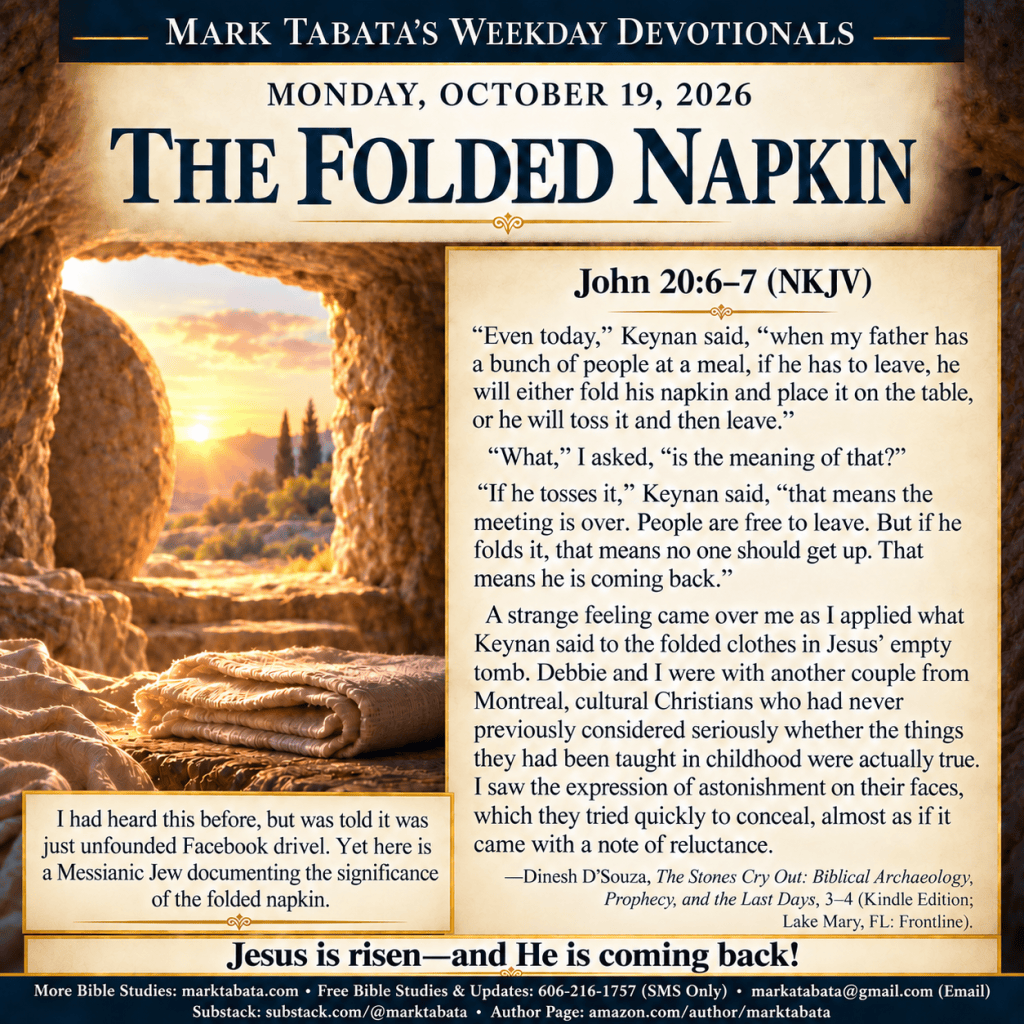
John 20:6-7-Then Simon Peter came, following him, and went into the tomb; and he saw the linen cloths lying there, 7 and the handkerchief that had been around His head, not lying with the linen cloths, but folded together in a place by itself.
Everything in the Bible is significant.
One example of this is found in what John records regarding the clothes that he and Peter found at the tomb where Jesus was resurrected. Please observe that John goes to great detail to document that there was a “handkerchief” that had been around Jesus’ head. He goes on to tell us that it was “”folded together in a place by itself.”
Why, someone might ask, would John include that detail?
Enter a man by the name of Dinesh D’Souza.
This gentleman has written several excellent books regarding Christianity and American history. In his most recent book on the subject of Biblical archaeology, The Stones Cry Out, he describes his recent and informative visit to Israel.
Keynan is a Messianic Jew—a Jewish believer in Jesus. He told us about Jewish customs of Jesus’ day and of today that give us a deeper understanding of the significance of this scene. “Even today,” Keynan said, “when my father has a bunch of people at a meal, if he has to leave, he will either fold his napkin and place it on the table, or he will toss it and then leave.” “What,” I asked, “is the meaning of that?” “If he tosses it,” Keynan said, “that means the meeting is over. People are free to leave. But if he folds it, that means no one should get up. That means he is coming back.” A strange feeling came over me as I applied what Keynan said to the folded clothes in Jesus’ empty tomb. Debbie and I were with another couple from Montreal, cultural Christians who had never previously considered seriously whether the things they had been taught in childhood were actually true. I saw the expression of astonishment on their faces, which they tried quickly to conceal, almost as if it came with a note of reluctance. (Dinesh D’Souza, The Stones Cry Out: Biblical Archaeology, Prophecy, and the Last Days, 3-4 (Kindle Edition): Lake Mary, FL: Frontline)
I had heard this before, but was told it was just unfounded Facebook drivel. Yet here is a Messianic Jew documenting the significance of the folded napkin. It teaches us some very important lessons.
First, in our studies of the Bible, we need to be willing to study outside of the Bible to better understand what is inside the Bible. The Bible itself authorizes this by referring time and again to uninspired books that are worthy of consideration. Examples include First Enoch, Jubilees, Jasher, 1 and 2 Maccabees, the Ascension Of Isaiah, The Testament of Job, etc. We should never be afraid of carefully examining other books that help us better understand the context and content of Scripture.
Second, this speaks to the factuality of the resurrection of Jesus from the dead. The folded napkin was a not so subtle reminder that Jesus arose from the grave, and by this act several things are shown to be true. By the resurrection of Jesus from the dead, Jesus is declared to be the Son of God with power (Romans 1:4), the fact of the Day of Judgment is assured (Acts 17:30-31), salvation is made possible (Romans 6:3-4), and the promise of new life in Christ and the hope of Heaven is secured (1 Peter 1:3-5).
Finally, Jesus is coming back!
Are we ready for that Day (Acts 2:37-47; 1 John 1:9)?
The grace of the Lord Jesus Christ, and the love of God, and the communion of the Holy Spirit, be with you all. Amen.


Leave a Reply