Thursday, November 5 2026
More Bible Studies Available @ http://www.marktabata.com. To Receive Free Bible Studies and updates via email, contact Mark Tabata @ 606-216-1757 (SMS Only) or mailto:markatabata@gmail.com (Email). Follow me on Substack: http://substack.com/@marktabata. Also, please visit my author page: http://amazon.com/author/marktabata
Exodus 4:21-And the LORD said to Moses, “When you go back to Egypt, see that you do all those wonders before Pharaoh which I have put in your hand. But I will harden his heart, so that he will not let the people go.
One of the objections that people often raise against the Bible is in regard to God hardening the heart of the Pharaoh.
The Jewish people had been slaves in the land of Egypt for some four hundred years when God sent Moses to deliver and lead them to the Promised Land of Canaan. However, God declared that He would “harden” the hearts of Pharaoh (the leader of Egypt) so that he would not allow the Jewish people to go free.
What shall we make of this?
Did God take away the freewill of this man like some kind of Divine dictator?
Let’s study.
First, the Pharaoh of Egypt in the time of Moses was a cruel and wicked man long before God’s declaration that He would harden his heart. It is not as if Pharaoh was some kind-hearted and gentle fellow that God took and made into a terrible despot so that He could then carry out His plans! Look at how God describes the treatment of the Jewish people under the reign of this ruler.
Exodus 3:7-And the LORD said: “I have surely seen the oppression of My people who are in Egypt, and have heard their cry because of their taskmasters, for I know their sorrows.
The Pharaoh was already a very wicked man before Moses was sent to him.
“With Pharaoh, we see a man already shaking his fist in defiance even as Moses first issued God’s command: “Who is the LORD, that I should obey him and let Israel go? I do not know the LORD and I will not let Israel go” (Ex 5: 2). We see that Pharaoh was obstinate even before God began to harden his heart. It is apparent that God did not transform Pharaoh from a meek and mild gentleman to the fire-breathing dragon Moses met; rather God strengthened Pharaoh’s heart in the perverse direction Pharaoh himself had already resolutely chosen.” (Jerry L. Walls, Joseph R. Donnell, Why I Am Not a Calvinist, 88-89 (Kindle Edition): Downers Grove, IL: IVP Academic)
Second, please consider the process by which this hardening of Pharaoh’s heart took place. By the time of Exodus 7, God still had not hardened Pharaoh’s heart.
Exodus 7:3-And I will harden Pharaoh’s heart, and multiply My signs and My wonders in the land of Egypt.
In fact, God is not said to harden Pharaoh’s heart until the events of Exodus 9.
Exodus 9:12-But the LORD hardened the heart of Pharaoh; and he did not heed them, just as the LORD had spoken to Moses.
Speaking of this, the LORD later tells Moses:
Exodus 10:1-Now the LORD said to Moses, “Go in to Pharaoh; for I have hardened his heart and the hearts of his servants, that I may show these signs of Mine before him,
What happens in between Exodus 4 and 10 when God finally is said to harden Pharaoh’s heart?
Exodus 7:13-And Pharaoh’s heart grew hard, and he did not heed them, as the LORD had said.
Exodus 7:22-Then the magicians of Egypt did so with their enchantments; and Pharaoh’s heart grew hard, and he did not heed them, as the LORD had said.
Exodus 8:15-But when Pharaoh saw that there was relief, he hardened his heart and did not heed them, as the LORD had said.
Exodus 8:19-Then the magicians said to Pharaoh, “This is the finger of God.” But Pharaoh’s heart grew hard, and he did not heed them, just as the LORD had said.
Exodus 8:32-But Pharaoh hardened his heart at this time also; neither would he let the people go.
Exodus 9:7-Then Pharaoh sent, and indeed, not even one of the livestock of the Israelites was dead. But the heart of Pharaoh became hard, and he did not let the people go.
Exodus 9:35-So the heart of Pharaoh was hard; neither would he let the children of Israel go, as the LORD had spoken by Moses.
Several times we are told that Pharaoh hardened his own heart, long before God is said to have hardened his heart!
Third, the wording of the passage strongly suggests that God allowed Pharaoh’s heart to become hardened, in full cooperation with Pharaoh’s own choices.
In chapter 11 of Volume 1: God’s Path to Victory, we note that Pharaoh had already made his moral choice of direction in oppressing God’s people before ever God did any action on him in ‘hardening’. In the present chapter we want to look more closely at the three different Hebrew words used for ‘hardening’ in the passages. The root forms of the three words are chazak, kabed and qashah. The various conjugations of Hebrew verbs (Hiphil (hi.), Piel (pi.), Qal, etc) are not only spelled differently, but may have rather different meanings. To make this study easier for the English reader a Hebrew verb has always been signified by the root form whatever its conjugation. Biblical Hebrew, of course, had no vowels, and so chazaq can also be transcribed as ḥzq and kabed as kbd, etc. In regard to the general usage, it will be useful to bear in mind that qashah is used only twice, once with God and once with Pharaoh as agent….As the text stands, kbd mostly refers to Pharaoh’s hardening of his own heart, and ḥzq to God’s hardening of Pharaoh’s heart. Correspondingly, in 1 Samuel 6: 6 the narrator retells Pharaoh’s own act with kbd, and in Joshua 11: 20 God’s hardening of Pharaoh’s heart with ḥzq. (vol 2, p 750) Considering now the three terms each in turn: 1) Qashah (or qšh): Basic meaning: Stubborn Agent: God–Exodus 7: 3; Pharaoh–13: 15 Reference: To whole process not to any specific instance The basic meaning of the Hiphil form is given by VanGemeren as ‘make hard, heavy.’…The root is used only twice (Exodus 7: 3 and 13: 15); in one case the agent is God and in the other it is Pharaoh. In both cases it refers to the whole general process during which Pharaoh became progressively more set in his chosen path. In neither case is the word used to refer to any particular time or incident. 2) Kabed (or kbd): Basic meaning: Heavy/ Immovable/ Stubborn Agent: God–Exodus 10: 1; Pharaoh–Exodus 8: 15; 8: 32; 9: 34; 1 Samuel 6: 6; None–Exodus 7: 14; 9: 7 Reference: To obduracy–God confirming Pharaoh’s choice. VanGemeren (vol 2, p 577) states: ‘‘ weight’ is the central meaning of which the other uses are applications’ and gives ‘to honour, make heavy’ as the key words. Green states: The root kbd encompasses a wide range of meanings, which can be derived primarily from the basis meaning ‘be heavy’… Twice (Exodus 9: 7; Isaiah 59: 1) the qal is used with ‘heart’ or ‘ear’ to express stubbornness. The hiphil. . . functions primarily as the causative of the qal. . . The verbal adjective (Exodus 7: 14) and the qal (Exodus 9: 7) express the state of stubbornness; the hiphil (Exodus 8: 11,28[ 15,32]; 9: 34) describes Pharaoh’s stubborn reaction. In Ex. 10: 1, however, it is Yahweh who hardens Pharaoh’s heart; and in Isaiah 6: 10,74 the prophet is commanded to harden the heart of the people. (Theological Dictionary of the Old Testament, vol 7, p 19–21) Usually it is Pharaoh who makes his own heart stubborn/ unresponsive. The only single time God is given as the agent is in 10: 1, and (as we saw in chapter 11 in Volume 1: God’s Path to Victory) this is immediately after Pharaoh has ‘made stubborn’ his own heart for the third time–and that having then for the first time recognized that he is in the wrong. There is actually a further nuance in the Hebrew which is not conveyed by the English. The meaning of the Hiphil form of the verb, like the Piel, could consist of urging or causing others to do something. It may often be represented by such phrases as ‘to permit to’, ‘to declare to’, or ‘to help to’ (See Gesenius, or other standard grammars). This, perhaps, explains why Young in his literal translation gives ‘I have declared hard’ as the sense in Exodus 10: 1. Davidson’s Hebrew Grammar (1956, 24th edition, p 95) specifically lists a declaratory meaning as a possible one for the Hiph form of verbs. Perhaps Young understood by it that the Lord actively accepted, and would further and utilize Pharaoh’s ‘heavy’ heart for his own ends of revealing himself through increasingly wonderful signs. …But from the story as a whole I would certainly deduce, as you do, that Pharaoh was far from being an automaton. …c) Chazaq (or ḥzq) Basic meaning: Strengthen/ Make Firm Agent: God–Exodus (4: 21); 9: 12; 10: 20; 10: 27; 11: 10; 14: 4; 14: 8; 14: 17; Joshua 11: 20; None–Exodus 7: 13; 7: 22; 8: 19; 9: 35 Reference: To Pharaoh being or being made firm in his choice Green states: We take as our basic meaning ‘be/ become strong,’ from which all other meanings that are found can be derived. . . (vol 4, p 307) The basic meaning of this word group is one of ‘strength’ or ‘strengthen’, but it is also used in contexts where we would use words like ‘encourage’ or even ‘repair’. VanGemeren states that the verb occurs 390 times and gives the Piel meaning as: Strengthen, fortify, reinforce, repair, support, assist, encourage. . . When the obj. of the pi. is lēb. heart or pānim face the reference is to obduracy. (vol 2, p 64) The Hebrew word does not carry any of the evil or cruel connotations conveyed by the English phrase ‘hard-hearted.’ The phrase ‘strengthened his resolve’ would perhaps be a nearer English equivalent than ‘hardened his heart.’…The Piel form of the Hebrew root chazaq (or ḥzq) is used 7 times of Pharoah and the Egyptians and 55 times of other subjects For the 55 other subjects the overwhelmingly most common rendering in all the versions of the NKJV, RSV, ESV, NIV, NASB is ‘strengthen’ or ‘encourage’ or ‘repair’….All this detailed study, then, corroborates our understanding in our Volume 1: God’s Path to Victory chapters 11–12….Concerning Pharaoh, God’s strategy was to strengthen Pharaoh’s resolve in a process which led him into a foolish obstinate defiance, and demonstrated God’s deliverance of Israel. It was not about God deciding on individual eternal destinies, nor about determining who should or should not ‘turn from his ways and live.’ (Roger Forster, Paul Marston, God’s Strategy in Human History Volume 2 Reconsidering Key Biblical Ideas, 284-291 (Kindle Edition): Push Publishing)
God allowed Pharaoh’s heart to become obstinate and hard, in full cooperation with Pharaoh’s own decisions.
Finally, the hardening of Pharaoh’s heart was not to such a degree that he could not have still repented and submitted to the Lord! We see this clearly in one of the accounts in Exodus. There, God tells Moses that He had hardened the hearts of Pharaoh and his servants, and yet we then see that the servants repented (Exodus 10:1-7)!
“This verse proves that God’s “hardening” Pharaoh’s heart did not deprive Pharaoh of free will. God also hardened the courtiers’ hearts (Exodus 10.1), yet, unlike Pharaoh, they decided the Israelites should be allowed to leave Egypt.” (Dennis Prager, The Rational Bible: Exodus, 113 (Kindle Edition): Washington, DC: Regnery Faith)
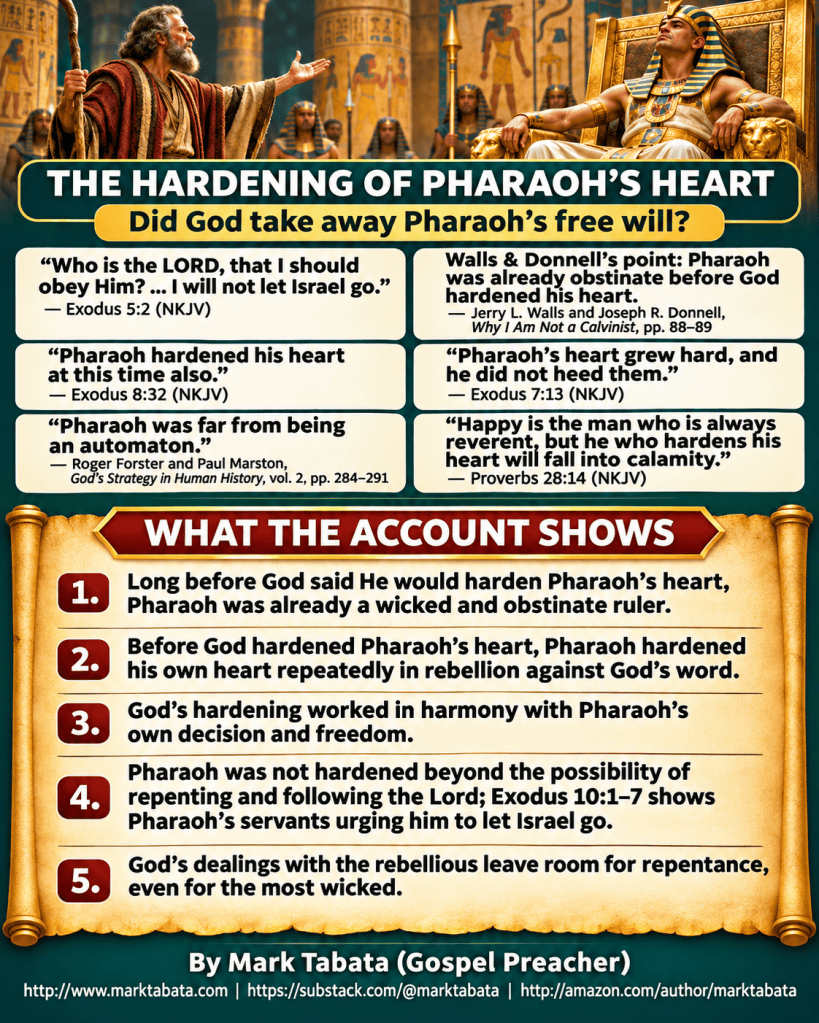
Adding it all together, here is what we see.
Long before God says that He would harden Pharaoh’s heart, the Pharaoh is clearly a wicked and obstinate ruler.
Before God hardens Pharaoh’s heart, Pharaoh hardens his own heart numerous times in rebellion to the Word of God.
When God does harden Pharaoh’s heart, it is in full harmony with Pharaoh’s own decision and freedom.
The hardening of Pharaoh’s heart by God was not to such a degree that the Pharaoh still could not have repented and followed the Lord.
God hardens the hearts of those who have rejected Him, who continue to reject Him, in harmony with their freewill, and yet He always leaves open the possibility for even the most wicked to repent.
How is your heart before the Lord?
Proverbs 28:14-Happy is the man who is always reverent, But he who hardens his heart will fall into calamity.
Lord, help us to keep our heart soft and willing to receive Your Word and correction. Amen.


Leave a Reply