Tuesday, November 17 2026
More Bible Studies Available @ http://www.marktabata.com. To Receive Free Bible Studies and updates via email, contact Mark Tabata @ 606-216-1757 (SMS Only) or mailto:markatabata@gmail.com (Email). Follow me on Substack: http://substack.com/@marktabata. Also, please visit my author page: http://amazon.com/author/marktabata
Matthew 24:35-Heaven and earth will pass away, but My words will by no means pass away.
Muslims are taught that the New Testament was intentionally corrupted by the early Christians. As we observed in our last study, that argument is easily refuted by the evidence. However, we are going to investigate the subject further so that we may not only be assured of the certainty of the things in which we have been instructed (Luke 1:1-4), but to better equip ourselves to reason with our unbelieving neighbors (Acts 17:17; 1 Peter 3:15).
Islamic arguments that suggest the New Testament was corrupted by early Christians rests mainly on the subject of textual variants.
A textual variant is a difference between manuscript copies of the New Testament.
In order to understand the subject, we need to realize how our New Testament has come down to us. Our knowledge of these 27 Books comes from three sources.
“1. It is well known that for determining the Text of the New Testament, we are dependent on three chief sources of information: viz. (1.) on MANUSCRIPTS,—(2.) on VERSIONS,—(3.) on FATHERS.” (John William Burgon, The Last Twelve Verses According To Saint Mark, 363-368 (Kindle Edition): James Parker & Company)
The Greek manuscripts are copies of the original Books of the New Testament.
The versions are translations of the Greek New Testament into other languages.
How many copies of the Greek manuscripts and early versions do we have today?
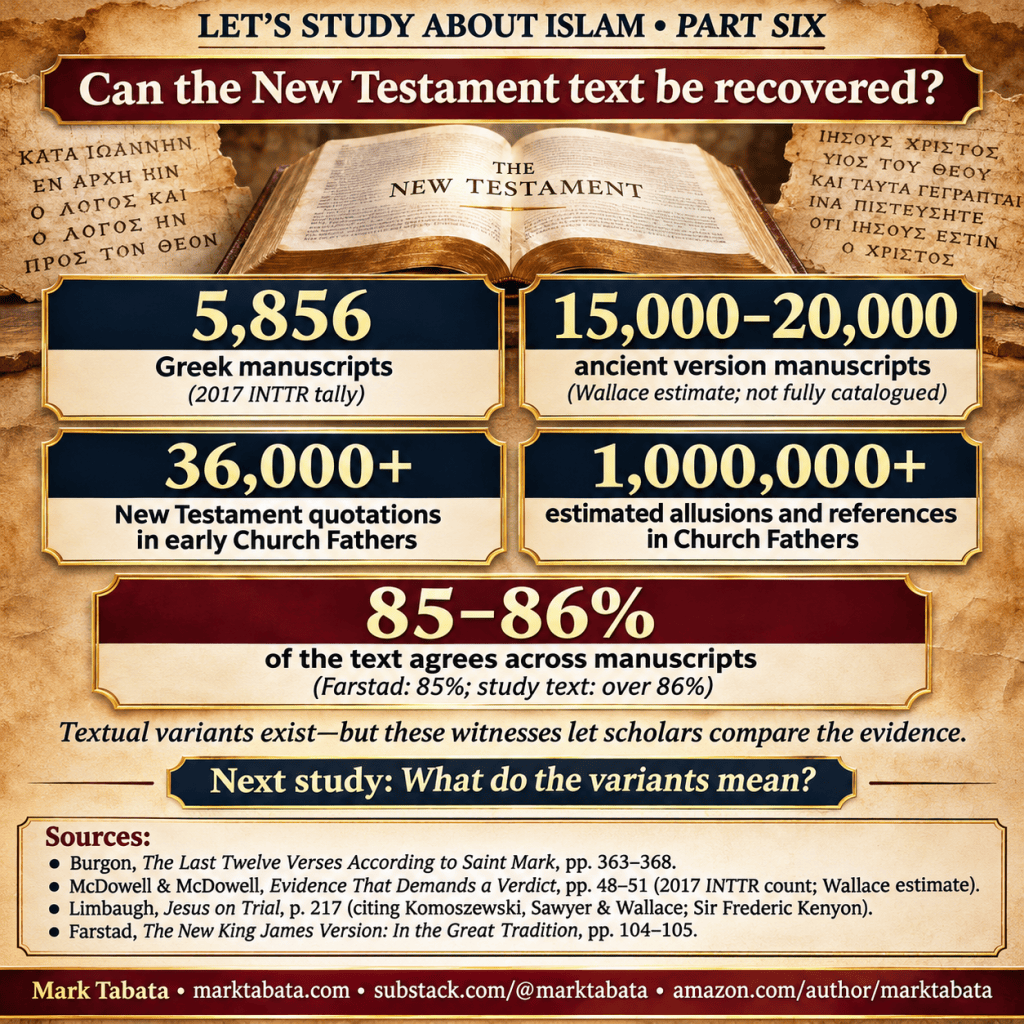
The current number according to the Institut für neutestamentliche Textforschung (Institute for New Testament Textual Research, hereafter the INTTR) in Münster, Germany, the official cataloger of Greek NT MSS, is c. 5,856. This includes papyri, majuscules, minuscules, and lectionaries (for more information about these manuscript types, see chapter 2). According to their tally from January 2017: minuscules = 2,937; majuscules (uncials) = 323; papyri = 131; lectionaries = 2,465 for a total of 5,856.…Wallace concludes that “all told, probably between fifteen and twenty thousand texts of the ancient versions of the New Testament remain. There are no exact numbers because not all the manuscripts have been carefully catalogued.” (Wallace, correspondence to J. McDowell and M. J. Tingblad, June 3, 2016). (Josh McDowell, Sean McDowell, Evidence That Demands a Verdict: Life-Changing Truth for a Skeptical World, 48-51 (Kindle Edition): Nashville, TN: Thomas Nelson Publishers)
So, we have today some 5, 856 manuscript copies of the Greek New Testament, and over 20, 000 manuscript copies of the early versions.
In addition to this, we have over 36, 000 quotations of the New Testament from the church fathers (i.e., the Christians from the late first to fourth centuries A.D.). It is even estimated that if we tallied all allusions and references in the church fathers, there would be well over a million!
Here’s another astonishing fact: the early Church fathers—Origen, Clement, Tertullian, Irenaeus, Ignatius, Polycarp, etc.—prolifically cited the New Testament in their writings. Just a few of the early fathers alone account for 36,000 New Testament citations, but the number of such citations from all the Church fathers exceeds one million. “So extensive are these citations,” say Komoszewski, Sawyer, and Wallace, “that if all other sources for our knowledge of the text of the New Testament were destroyed, they would be sufficient alone for the reconstruction of practically the entire New Testament.” 71 And as Sir Fredric Kenyon observes, “The number of manuscripts of the New Testament, of early translations from it, and of quotations from it in the oldest writers of the Church, is so large that it is practically certain that the true reading of every doubtful passage is preserved in some one or other of these ancient authorities. This can be said of no other book in the ancient world.” 72. (David Limbaugh, Jesus on Trial: A Lawyer Affirms the Truth of the Gospel, 217 (Kindle Edition): Washington, DC: Regnery Publishing)
When you compare all of the Greek manuscripts, you find that they are over 86 % identical, and corroborated by the early versions of early church fathers quotations!
(17). There are over five thousand manuscripts of the Greek New Testament, although only one manuscript contains a whole Testament. This number is far greater than the number of manuscripts supporting the Greek and Latin classics, some of which have a mere handful of ancient manuscripts. The Greek manuscripts of the New Testament were written very soon after the writing of the original texts. The manuscripts are from various parts of the ancient world-Palestine, Asia Minor, Egypt, and the West. Because so much has been said about textual variants, many people have received the impression that the New Testament is on shaky ground. Not so! Fully eighty-five percent of the text is the same in all types of manuscripts. As for the other fifteen percent, we should point out that much of the material concerns details that do not even show up in an English translation. Such things as word order, spelling, and slightly variant forms of some verbs seldom are reproduced in translation. Most of the variations are caused by accidental copyists’ errors. (Arthur L. Farstad, The New King James Version: In the Great Tradition, 104-105 (Kindle Edition): Nashville, TN: Thomas Nelson Publishers)
However, that still leaves fifteen percent of the New Testament where there are differences between those manuscripts (i.e., textual variants). Between those manuscripts, that amounts to hundreds of thousands of variants in the text!
How can we account for those many variants?
Does this imply that we cannot trust our New Testament (as Muslims claim)?
These questions will be the focus of our next study.
The grace of the Lord Jesus Christ, and the love of God, and the communion of the Holy Spirit, be with you all. Amen.


Leave a Reply