Mark Tabata’s Weekday Devotionals
Tuesday, October 13
More Bible Studies Available @ http://www.marktabata.com. To Receive Free Bible Studies and updates via email, contact Mark Tabata @ 606-216-1757 (SMS Only) or mailto:markatabata@gmail.com (Email). Follow me on Substack: http://substack.com/@marktabata. Also, please visit my author page: http://amazon.com/author/marktabata
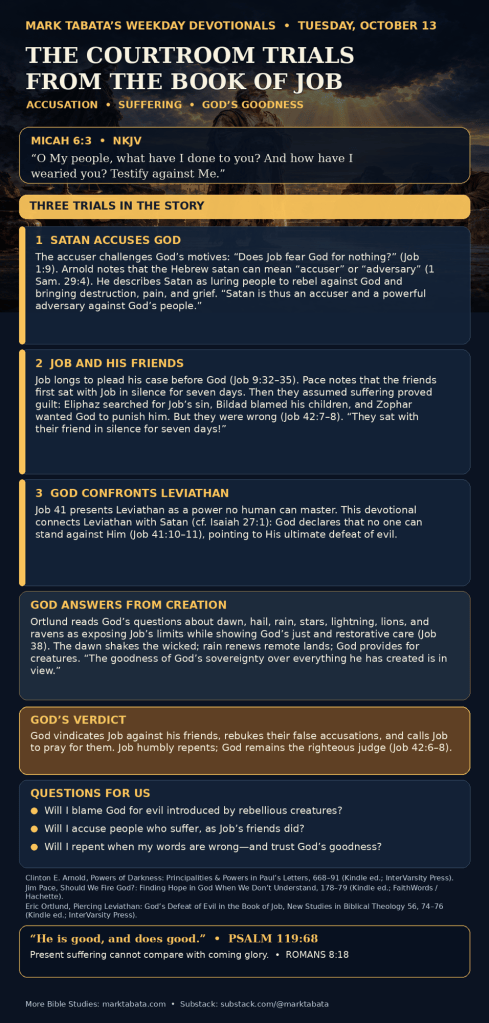
Micah 6:1-3-Hear now what the LORD says: “Arise, plead your case before the mountains, And let the hills hear your voice. 2 Hear, O you mountains, the LORD’s complaint, And you strong foundations of the earth; For the LORD has a complaint against His people, And He will contend with Israel. 3 “O My people, what have I done to you? And how have I wearied you? Testify against Me.
Have you ever stopped to consider that the Book of Job is like a series of court trials?
First, you have Satan putting God Himself on trial. This really makes sense, because the name “Satan” literally means “accuser.”
Satan’s activity of bringing accusation is more in line with the extended usage of the Hebrew term satan. In the Old Testament the word is used elsewhere with the simple meaning ing of “accuser” or “adversary.” The writer of 1 Samuel records, for instance, that the Philistines were opposed to David fighting with them, “lest in the battle he become an adversary [satan] to us” (1 Sam 29:4 RSV). Satan is thus an accuser and a powerful adversary against God’s people. He performs his hostile functions against them by luring them into rebelling against the express will of God and by causing even physical destruction, pain and grief. In spite of Satan’s powerful malignant activity, God’s people are called to maintain their pure devotion to the Lord. (Clinton E. Arnold, Powers of Darkness: Principalities & Powers in Paul’s Letters, 668-691 (Kindle Edition): Downers Grove, IL: InterVarsity Press)
God is the Defendant, with Satan as the first district attorney. The “sons of God” (another name for the angels) are the jury. Yet they are also the subjects who could suffer the worse if they end up believing Satan’s charges against God, for then they could very easily rebel against God and be condemned to hell (Jude 6-7).
Later, Job himself wishes he could serve as the prosecuting attorney against God.
Job 9:2-3-Truly I know it is so, But how can a man be righteous before God? 3 If one wished to contend with Him, He could not answer Him one time out of a thousand.
Job 9:32-35-For He is not a man, as I am, That I may answer Him, And that we should go to court together. 33 Nor is there any mediator between us, Who may lay his hand on us both. 34 Let Him take His rod away from me, And do not let dread of Him terrify me. 35 Then I would speak and not fear Him, But it is not so with me.
Job doesn’t realize that in his speeches, he is already testifying against God, just like he wished!
Second, you have Job on trial. The ones prosecuting him-Eliphaz, Bildad, and Zophar- are his friends (although that is hard to see throughout the Book as they are not perhaps very “friendly” towards the patriarch). They are testifying against Job, saying that all the suffering that he endures is somehow his fault.
But help is on the way. Job’s buddies have heard of his problems and are coming to comfort their friend. And they are remarkable at it. The first thing they do is sit with him without saying a word for seven days! That is support. Day eight, they adjust their strategy. Eliphaz suggests that Job must have done something to earn what he is getting. In his view of God, admittedly very primitive, you get what you deserve. For this caliber of suffering to fall on his friend, something bad must have been going on in Job’s world. Eliphaz seemed to genuinely care for his friend. He was just trying to get him to admit his failures. The only problem was that Job couldn’t figure out what he had done to cause all the pain and loss. Then Bildad jumps in. Bildad suggests it was the wrongdoing of Job’s children that brought disaster on him. In Bildad’s world-view, the lightning strikes pretty close to the infraction. You see in the B.C. comic strip the misadventures of several prehistoric people. Someone does something wrong and then there’s a massive ZOT! And the wrongdoer is toast. Bildad was trying to help his friend see that Job’s kids had gotten out of hand, so God took care of it. Done and done. The final friend, Zophar, even goes so far as to hope that God will soon start to go after Job for his insistence that he didn’t do anything to bring this on himself. All these guys seemed to care for Job in his deep suffering—remember, they sat with their friend in silence for seven days! The only problem was that they were wrong. Finally, God does speak. He challenges many of Job’s anguished words, but he never once says that Job’s friends were right. He makes it clear that Job didn’t deserve what happened—only that there was much more going on than Job could possibly understand. (Jim Pace, Should We Fire God?: Finding Hope in God When We Don’t Understand, 178-179 (Kindle Edition): New York, NY: FaithWords Hachette Book Group)
We learn later that Job’s friends are as wrong about Job and God, as Job himself is about God! God’s questions in Job 38-41 vindicate Him and His goodness. Indeed, the creation itself is called to testify of God’s glory and grace.
Even if it is not meant literally, God’s description of the sunrise speaks clearly to a central aspect of Job’s protest: far from an amoral dictatorship in which the earth is under the power of the wicked (9:24), God’s strategy for creation structures the natural order in such a way that it works against human evil, shaking the wicked out of the earth (v. 13). Job cannot command the sunrise or teach the dawn its place – but God can, and does, to blessed effect. Taken together with verses 8–11, we see God’s nurturing gentleness with and containment of his enemies (whether human or supernatural) nuanced by his defeat of them. In sharp contrast to Job’s criticisms, justice matters to God, and the orderliness of his creation enacts it.40…Furthermore, Job has never been to the storehouses of snow and hail (vv. 22–23). Since these are stored for the day of battle, when a nation is in trouble and needs to defend itself, and since God sometimes fights on behalf of his people with hail (Josh. 10: 11; Isa. 30: 30), 43 the implication in these two verses both emphasizes Job’s ignorance and reaffirms God’s goodness in intervening on behalf of the helpless. Nor can Job control the storm–if it were up to Job, the world might soon turn into a desert; but under God’s care, even those places far from human habitation are renewed (vv. 25–27). While Job claims that God’s control of rain is the worst of both worlds in that the only relief to a drought is an overwhelming flood (12: 15), God shows how he renews life in places far beyond Job’s ken. Furthermore, Job cannot generate the rain, cold or frost (vv. 28–30); nor can he guide the stars (vv. 31–33). 44 He does not even know the ‘ordinances’ of the heavens, the laws by which they function (v. 33). God made the heavenly lights to rule (Gen. 1), but if it were up to Job, this part of creation would fall apart. Nor can Job control or even fully understand the lightning (vv. 34–38). The second half of God’s speech transitions from different parts of his creation to the animals living in it. God’s care for lions and ravens is presented first (38: 39–41), the point being much the same as above: Job cannot provide or care for these animals, but God both can and does. Divine sovereignty is clearly emphasized in this short passage. But more importantly, the goodness of God’s sovereignty over everything he has created is in view. The same creation both Job and Job’s friends pointed to in order to substantiate their theological claims (e.g. 4: 10–11) takes on a happier meaning when interpreted by its creator. (Eric Ortlund, Piercing Leviathan: God’s Defeat of Evil in the Book of Job (New Studies in Biblical Theology 56), 74-76 (Kindle Edition): Downers Grove, IL: InterVarsity Press)
God Himself, vindicated by creation and by Job’s repentance, then defends Job against his friends.
Job 42:6-8-Therefore I abhor myself, And repent in dust and ashes.” 7 And so it was, after the LORD had spoken these words to Job, that the LORD said to Eliphaz the Temanite, “My wrath is aroused against you and your two friends, for you have not spoken of Me what is right, as My servant Job has. 8 Now therefore, take for yourselves seven bulls and seven rams, go to My servant Job, and offer up for yourselves a burnt offering; and My servant Job shall pray for you. For I will accept him, lest I deal with you according to your folly; because you have not spoken of Me what is right, as My servant Job has.“
Third, we come to realize that Satan himself is on trial!
In Job 41, Satan is described under the name “Leviathan” (cf. Isaiah 26:19-27:1). God Himself declares his guilt, so that He will one Day rise up to fight against him and defeat him for all of the harm that he has done against humanity (Job 41:10-11, 33).
Now, all of this raises questions for each of us.
First, how often do we (like Satan and Job) accuse God unjustly for all the evil in our realm, when it was actually angelkind and humankind that introduced such into His original perfectly good universe (Genesis 1:31; 2:15-17; 3:1-19; Romans 5:12-21)?
Second, how often do we (like Job’s friends) unjustly accuse the innocent when they suffer some affliction (Luke 13:1-9; John 9:1-3)?
Third, will we (like Job) have the humility to repent of such unjust speech and wrongdoing (Acts 17:30-31)?
Finally, do we take heart and give thanks to God in the knowledge that He is good and that He does good (Psalm 119:68), that He is working even now (Habakkuk 1:1-6), and will one Day fully defeat Satan and the powers of darkness (Revelation 20:11-15)?
If you are facing some hardship or obstacle in your life, invite God in faith to work and bring good through it all.
He will!
Romans 8:18-For I consider that the sufferings of this present time are not worthy to be compared with the glory which shall be revealed in us.
Father, thank You for Your goodness. Forgive us when we in ignorance say things against You (or others) that we shouldn’t. Please work in our hearts and our lives. In Jesus’ Name we pray, Amen.


Leave a Reply