Monday, November 2 2026
More Bible Studies Available @ http://www.marktabata.com. To Receive Free Bible Studies and updates via email, contact Mark Tabata @ 606-216-1757 (SMS Only) or mailto:markatabata@gmail.com (Email). Follow me on Substack: http://substack.com/@marktabata. Also, please visit my author page: http://amazon.com/author/marktabata
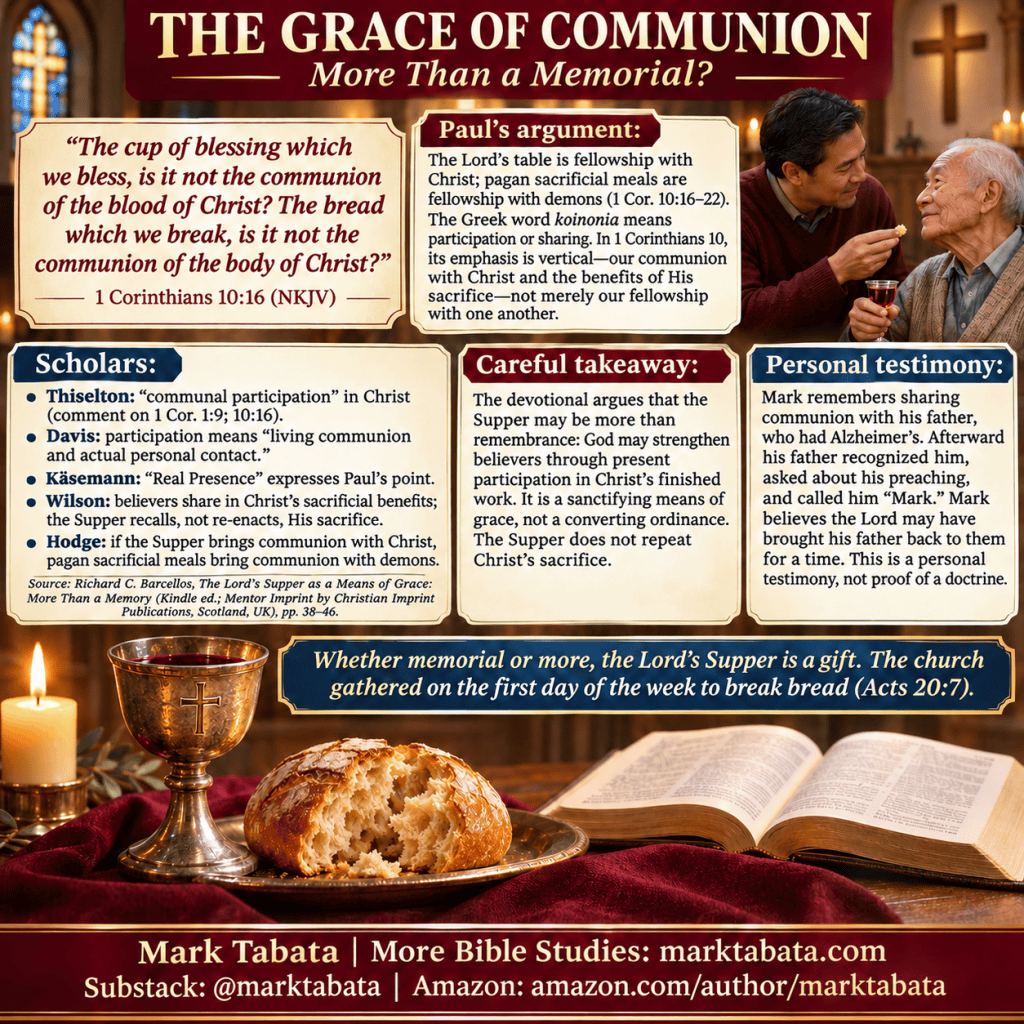
1 Corinthians 10:16-22-16 The cup of blessing which we bless, is it not the communion of the blood of Christ? The bread which we break, is it not the communion of the body of Christ? 17 For we, though many, are one bread and one body; for we all partake of that one bread. 18 Observe Israel after the flesh: Are not those who eat of the sacrifices partakers of the altar? 19 What am I saying then? That an idol is anything, or what is offered to idols is anything? 20 Rather, that the things which the Gentiles sacrifice they sacrifice to demons and not to God, and I do not want you to have fellowship with demons. 21 You cannot drink the cup of the Lord and the cup of demons; you cannot partake of the Lord’s table and of the table of demons. 22 Or do we provoke the Lord to jealousy? Are we stronger than He?
When studying the Bible, there is no doubt that the Lord’s Supper is a memorial.
But is the Lord’s Supper ONLY a memorial?
Many believe that the Lord’s Supper is a channel through which God strengthens His people, imparting some kind of special grace in order to help them in the daily struggles of life. One passage which may suggest this is here in 1 Corinthians 10.
Let’s study.
In the text before us, Paul is encouraging the Christians not to become involved in pagan religions. He says that Christians engage in “communion” with the body and blood of Christ when they partake of the Lord’s Supper, and that it is inappropriate to afterwards “fellowship” with the table of of demons by partaking in heathen worship.
The word translated “communion” is koinonia, and we learn a great deal from it.
When trying to determine the meaning of a word it is often helpful to study its use elsewhere, especially if it is used in the same book of the Bible under consideration. Koinonia is used elsewhere in 1 Corinthians at 1:9: ‘God is faithful, through whom you were called into fellowship [koinonia] with His Son, Jesus Christ our Lord.’ Anthony Thiselton argues for a vertical emphasis for koinonia here and translates it ‘communal participation.’…Coming back to 1 Corinthians 10:16, Thiselton says that in this context, koinonia has a ‘vertical and theological priority of emphasis over the horizontal and social’.11 The Lord’s Supper certainly has horizontal and social aspects to it (cf. 1 Cor. 11:17ff.), but in 1 Corinthians 10:16 in light of Paul’s argument against idolatry (see my comments above and below), he is dealing with its nature in terms of its vertical aspect – that which we commune with, not the fact that we are communing. John Jefferson Davis says, ‘… participation implies living communion and actual personal contact.’12 But actual personal contact with what or whom? Thiselton further adds it means ‘having an active common share in the life, death, resurrection and presence of Jesus Christ as the Lord.’13 Ernst Käsemann observes, ‘Whatever objections may be raised against the term “Real Presence,” it expresses what Paul wants to say.’14 What these men are saying is that koinonia in 1 Corinthians 10:16 expresses a vertical, top-down reality, a reality connected to ‘the blood’ and ‘the body of Christ’. Paul’s emphasis is not that believers are together when they partake of the Lord’s Supper (though that is true), it is that koinonia constitutes some sort of relationship with ‘the blood’ and ‘the body of Christ’….While discussing koinonia when it is modified by a genitive case noun (or nouns as in our case), BDAG says it could mean ‘the common possession or enjoyment of someth[ing]’.16 What is the thing or what are the things that are the common possession(s) or enjoyment of the Corinthians to which Paul is referring? The answer is ‘the blood of Christ’ and ‘the body of Christ’. How do believers possess or enjoy ‘the blood of Christ’ and ‘the body of Christ’ through the Lord’s Supper? We must look into this further. The New International Dictionary of New Testament Theology says, ‘koinonia in 1 Corinthians 10:16 means “participation” in the body and blood of Christ and thus union with the exalted [emphasis mine] Christ.’17 If Paul is talking about a present communion with ‘the blood’ and ‘the body of Christ’ and if Christ is no longer dying or dead, then the communion he is referring to is communion with the living, exalted Christ now. This is present communion with the living and exalted Lord of glory. The communion must be with the present benefits procured by his broken body and shed blood, for his body is no longer broken (it is glorified) and his blood has finished its shedding. Geoffrey B. Wilson agrees: The fact that Paul here refers to the sharing of the cup and the bread as a ‘communion’ of the blood and body of Christ proves that the Lord’s Supper is something more than a memorial meal. For the believer shares in all the benefits of Christ’s sacrifice [emphasis added] as he partakes of the tokens by which it is recalled but not re-enacted. ‘The bread and wine are vehicles of the presence of Christ. … Partaking of bread and wine is union (sharing) with the heavenly Christ’ (F. Hauck, TDNT, Vol. 3, p. 805).1….It must be that participating in pagan sacrificial meals opens one up to the influence of demons. This sharing involves some sort of contact with demons and is, thus, a form of idolatry (1 Cor. 10: 14). This is why Paul says, ‘You cannot drink the cup of the Lord and the cup of demons; you cannot partake of the table of the Lord and the table of demons’ (1 Cor. 10: 21). Regarding this verse, H. Bietenhard says: To sit down at the table of the kyrios [Lord] is to receive food from him and through it enter communion with him. Correspondingly, anyone who takes part in pagan sacrificial meals enters into communion with demons. … The two activities are utterly incompatible. 24 John Gill’s comments are helpful at this juncture: The apostle’s view in this instance, and his argument upon it, is this, that if believers, by eating the bread and drinking the wine in the Lord’s supper, spiritually partake of Christ, of his body and of his blood, and have communion with him; then such who eat of things sacrificed unto idols, have in so doing communion with them, and partake of the table of devils, and so are guilty of idolatry, which he would have them avoid. 25 I think Gill is right, as long as we understand that Paul is dealing with pagan sacrificial meals in 10: 14-22. The point of the text The point being made from this text is that bread and wine are signs which signify present participation or present communion in the present benefits procured by Christ’s body and blood. Grace procured by what Christ did for us becomes ours through the Lord’s Supper. It is a means of grace. This is why the seventeenth-century English Particular Baptist Benjamin Keach, a signatory of the 2nd LCF, said, ‘There is a mystical conveyance or communication of all Christ’s blessed merits to our souls through faith held forth hereby, and in a glorious manner received, in the right participation of [the Lord’s Supper].’ 26 Likewise, in the nineteenth century, C. H. Spurgeon said, ‘At this table, Jesus feeds us with his body and blood …’ 27 Koinonia of the blood and body of Christ means spiritual nourishment is brought to souls. It is present participation in the present benefits of Christ’s death for those properly partaking. In other words, the Lord’s Supper is a means of grace. Paul brings up the nature of the Lord’s Supper as a means of grace in this text to argue against participating in pagan sacrificial meals, which is idolatry. As Charles Hodge asserts, ‘It is here assumed that partaking of the Lord’s Supper brings us into communion with Christ. If this be so, partaking of the table of demons must bring us into communion with demons. This is the apostle’s argument.’ 28 Any view of the Supper as only horizontal or memorial does not fit the context or prove the point of Paul’s argument….Though it is not a converting ordinance, the Supper is a sanctifying ordinance. Like the Word of God and prayer, it is a means through which grace comes to us from Christ. It is not a means of special grace, but a special means of grace.30 Through the Lord’s Supper we receive something from Christ – the benefits of his body and blood. We are served something from Christ. The benefits of his body and blood are brought to us. As Bavinck said long ago, ‘He not only gave himself for his own; he also gives himself to his own.’31 We ought to look at the Supper as an event through which we receive and not only give. That which we receive is a top-down gift from heaven to earth, from our glorified Redeemer to us. (Richard C. Barcellos, The Lord’s Supper as a Means of Grace: More Than A Memory, 38-46 (Kindle Edition): Scotland, UK: Mentor Imprint by Christian Imprint Publications)
The fact that the “communion” of Christ’s body and blood is paralleled with the influence of the “communion” of demonic powers strongly suggests that the Lord’s Supper is much more then a memorial service.
Why?
Because people who communed with demons in the Bible did not merely memorialize them. They were often affected in other ways through such fellowship.
In the same way, it is possible that the Lord’s Supper somehow strengthens and empowers Christians as they participate in the benefits of Christ’s death and resurrection.
I remember an event in my life that I believe demonstrates this in some ways. My father passed away of Alzheimers Disease. Quite often, he had no memory of who I was. Some days, he did not remember that he had children at all. He often just called me “Bubba” when we were together. He often forgot any memory that I am a Gospel Preacher, or of the dangerous circumstances with corrupt police officers which had transpired in Hazard that forced us to leave our home there of twenty years.
Shortly before he passed away, I was preaching and visiting with the brethren in Friendship, Ohio. Before leaving my parents home and returning to Corbin, he, my mother, and I celebrated communion together.
On that trip and to that point, he did not know me.
I was “Bubba.”
After we prayed and partook of the Lord’s Supper, he remembered me.
He asked me if I am still preaching.
Had we gotten settled after what happened in Hazard?
And you know what he called me?
I was not “Bubba.”
It was “Mark.”
Now, some might ask, could it not just be a coincidence?
Perhaps.
But personally, I believe that the Lord-through the communion-brought him more fully back to us, for a time.
Whether the Supper is only a memorial or not, it is a blessing that God has given to His people. It is one reason that we gather together on the first day of every week-Sunday-and partake of those emblems (Acts 20:7).
Can you think of ways that the Lord’s Supper strengthens you?
Lord, thank You for Your Supper. We praise You for the connection we have through it with You, and with each other. Help us look to You each day. In Your Name we pray, Amen.


Leave a Reply