Monday, November 9 2026
More Bible Studies Available @ http://www.marktabata.com. To Receive Free Bible Studies and updates via email, contact Mark Tabata @ 606-216-1757 (SMS Only) or mailto:markatabata@gmail.com (Email). Follow me on Substack: http://substack.com/@marktabata. Also, please visit my author page: http://amazon.com/author/marktabata
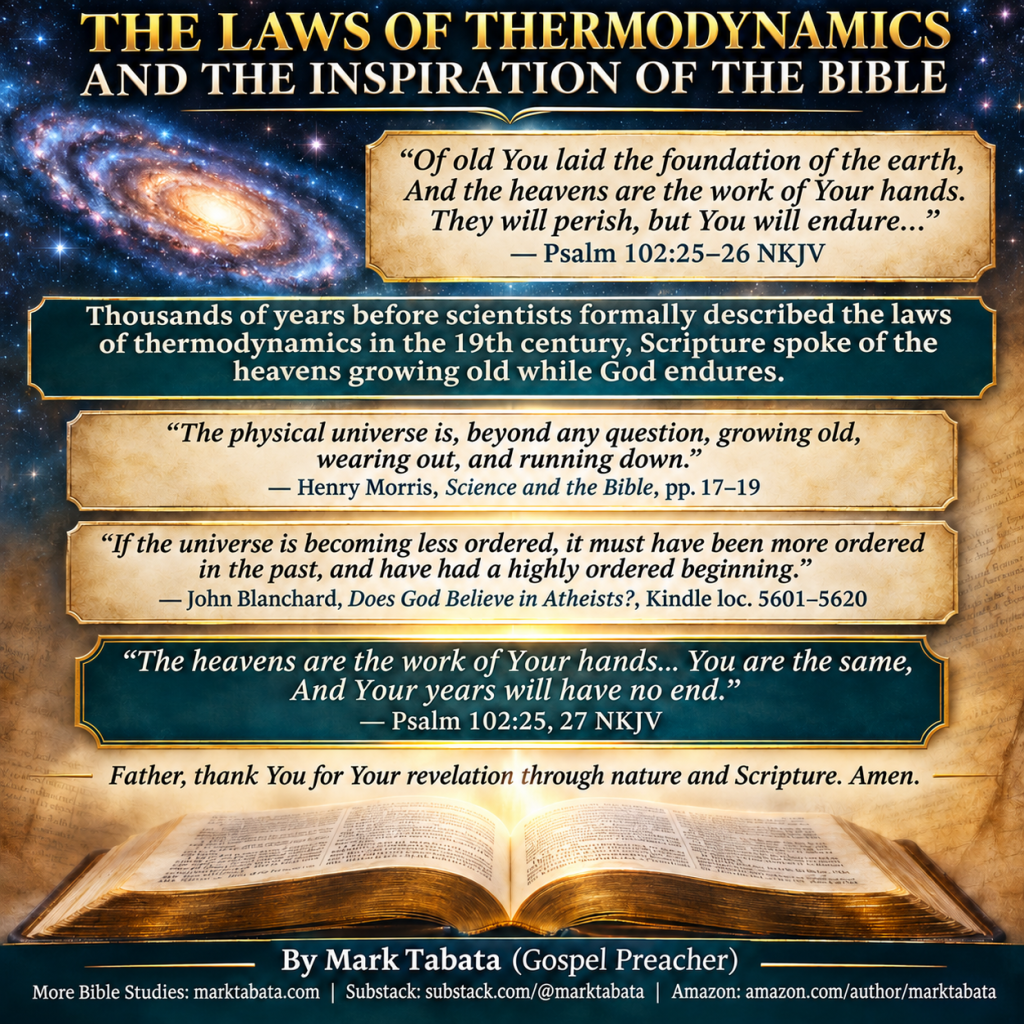
Psalm 102:25-27-Of old You laid the foundation of the earth, And the heavens are the work of Your hands. 26 They will perish, but You will endure; Yes, they will all grow old like a garment; Like a cloak You will change them, And they will be changed. 27 But You are the same, And Your years will have no end.
When studying with those who reject the Bible as the Word of God, I frequently share different evidences which document that the Scriptures are indeed inspired of Him. One such evidence comes from the field of the scientific foreknowledge of the Bible writers. This focuses on the fact that the Bible writers had incredibly advanced scientific foreknowledge when contrasted with the wisdom of their time, and that this knowledge (often being confirmed recently by modern science) points to their Divine inspiration.
One example comes from the laws of thermodynamics.
Even more significant than the many specific facts of science in the Bible is the remarkable truth that the most universal principles of science are also there. These are the laws of energy conservation and deterioration. The law of energy conservation states that in a closed system, in any transformation of energy from one form of energy into another (and everything that happens involves such energy transformations), the total amount of energy in the system remains unchanged. No energy is either created or destroyed. A similar law is the law of mass conservation, which states that although matter may be changed in state, density, or form, its total mass is unchanged. In other words, these basic laws teach that no creation or destruction of matter or energy is now being accomplished anywhere in the physical universe. Since matter and energy are themselves interchangeable under certain conditions, the two laws can be combined into the principle that the total of mass-plus-energy is conserved. These conservation laws were not demonstrated quantitatively by scientists until the nineteenth century. However, the Bible has taught for thousands of years the same great truth—that genuine creation is no longer taking place, contrary to the evolutionary philosophy of continuing creation. For example, Hebrews 4: 3 says, “The works were finished from the foundation of the world.” The account of creation concludes with the summary statement: “Thus the heavens and the earth were finished, and all the host of them. And on the seventh day God ended his work which he had made” (Genesis 2: 1–2). This law of mass-and-energy conservation, also known as the first law of thermodynamics, is generally recognized as the most important and basic law of science. The second law of thermodynamics, almost as great in significance as the first, states the corollary principle of mass/ energy deterioration. In any energy conversion, although the total amount of energy remains unchanged (Hebrews 1: 3 says that Christ is “upholding all things by the word of his power”), the amount of usefulness and availability that the energy possesses is always decreased. This principle is also called the law of entropy increase; entropy being a sort of mathematical abstraction that is actually a measure of the nonavailability of the energy of a system. Thus, in any isolated system (that is, a system from which all external sources of energy are shut off), the energy of the system is conserved in quantity but is continually being degraded in quality as long as any energy change is taking place in the system. Some of the available energy is always dissipated in nonrecoverable friction or heat energy. Since all activities of nature (including biological activities) involve such energy transfers, there must be an ever-decreasing supply of usable energy for maintaining all natural processes in the universe as a whole. This law of entropy increase is responsible for the fact that no machine can be constructed to 100 percent efficiency and for the fact that a perpetual motion machine is impossible. Practically all the earth’s energy comes, or has come, from the sun, but most of the tremendous energy output of the sun is dissipated in space in the form of unrecoverable heat energy. This prodigious waste of energy cannot last forever. Eventually, barring supernatural intervention, the sun must burn itself out, and then all activity on the earth must cease as well. The same principle applies to all the stars of the universe, so that the physical universe is, beyond any question, growing old, wearing out, and running down. But this in turn means that the universe had a definite beginning. If it is growing old, it must once have been young; if it is wearing out, it must first have been new; if it is running down, it must originally have been “wound up.” In short, this law of energy degeneration conveys us inexorably back to the necessary truth of the existence of a Creator and a definite creation, which must have been taken place in the past but which, according to the conservation principle, is not continuing in the present. Scripture frequently refers to this principle of universal deterioration. (Henry Morris, Science and the Bible, 17-19 (Kindle Edition): Chicago, IL: Moody Press)
These laws of science point to the existence of the eternal God, the origin of the universe (and its’ highly ordered arrangement at the’ beginning), and it’s eventual destruction.
Not everyone welcomed the Big Bang concept, some disliking the idea that the universe had a beginning because it strongly implied a supernatural creation. In 1948 Sir Fred Hoyle helped to formulate the ‘steady-state’ theory. This maintained that the universe was infinite and eternal and that the entire cosmic process was kept in balance as matter simply sprang into existence out of nothing at a regular rate to replace the matter which had ‘died’ through expansion. The biggest problem with this view is that it violates the First Law of Thermodynamics, sometimes known as the law of conservation of mass and energy. This fundamental law, which Isaac Asimov called ‘the most powerful and most fundamental generalization about the universe that scientists have ever been able to make’,24 states that matter and energy can neither be self-created nor destroyed…The First Law of Thermodynamics clearly supports the idea that an expanding universe must have had a beginning but could not have created itself. The Second Law of Thermodynamics, which states that any isolated physical system becomes less ordered and more random over time, provides another piece for the cosmic jigsaw. Applied very simply and generally, it means that our entire universe is running down. As the rotation of the planets and their moons slows down, and as stars (and whole galaxies) burn themselves out, the matter in our universe is becoming more and more disorganized as its energy is dissipated. The logical consequence of this is that the universe cannot be eternal. If it were, the stars would have ceased to shine long ago and all the energy in our universe would have long since been evenly spread throughout space. At the same time, this suggests that if the universe is becoming less ordered, it must have been more ordered in the past, and have had a highly ordered beginning. (John Blanchard, Does God Believe In Atheists? 5601-5620 (Kindle Edition); Carlisle, PA; EP Books USA)
The fact that the Bible writers understood these scientific principles thousands of years ago and which are just now being confirmed through modern experiments is one of the evidences that the Bible is God’s Word.
Father, thank You for Your revelation through nature and Scripture. Amen.


Leave a Reply