Friday, November 6 2026
More Bible Studies Available @ http://www.marktabata.com. To Receive Free Bible Studies and updates via email, contact Mark Tabata @ 606-216-1757 (SMS Only) or mailto:markatabata@gmail.com (Email). Follow me on Substack: http://substack.com/@marktabata. Also, please visit my author page: http://amazon.com/author/marktabata
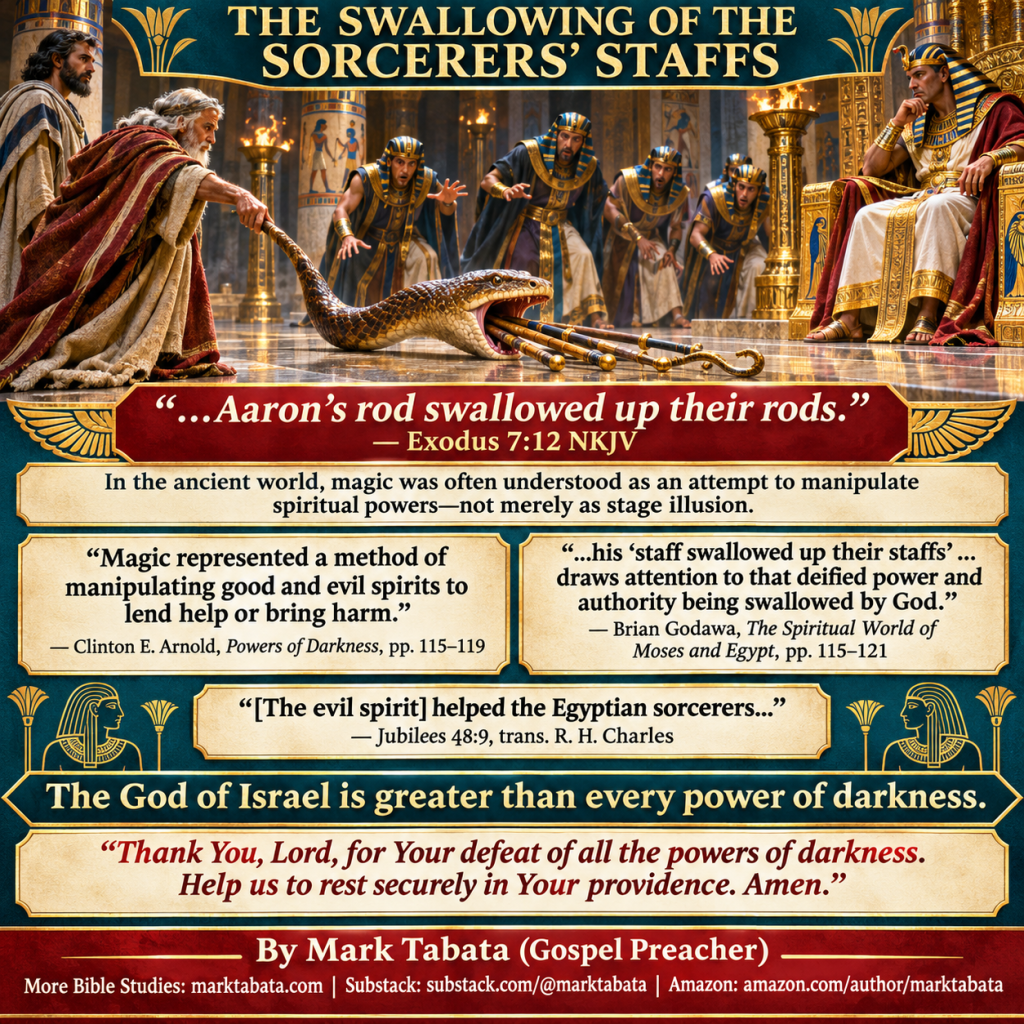
Exodus 7:10-13-So Moses and Aaron went in to Pharaoh, and they did so, just as the LORD commanded. And Aaron cast down his rod before Pharaoh and before his servants, and it became a serpent. 11 But Pharaoh also called the wise men and the sorcerers; so the magicians of Egypt, they also did in like manner with their enchantments. 12 For every man threw down his rod, and they became serpents. But Aaron’s rod swallowed up their rods. 13 And Pharaoh’s heart grew hard, and he did not heed them, as the LORD had said.
What is the significance of the staff of Moses swallowing the staffs of the sorcerers of Egypt?
Strange as it may sound, this was a very important detail.
In our day and age, magic is often thought of as trickery or illusion. Yet that is not the way such was viewed in the ancient world.
ONE OF THE CLEAREST WINDOWS FOR SEEING WHAT ORDINARY PEOPLE Believed about supernatural powers in the New Testament era is the realm of magic and divination. Magical beliefs and practices were a part of all religious traditions (and even came to have a share in Christianity!). In Western culture we have come to think of magic as harmless trickery in the context of entertainment. When we speak of magic during the period of the New Testament, however, we must realize it was not the art of illusion. Magic represented a method of manipulating good and evil spirits to lend help or bring harm. Magical formulas could be used for such things as attracting a lover or winning a chariot race. Black magic, or sorcery, involved summoning spirits to accomplish all kinds of evil deeds. Curses could be placed, competitors subdued, and enemies restrained. (Clinton E. Arnold, Powers of Darkness: Principalities & Powers in Paul’s Letters, 115-119 (Kindle Edition): Downers Grove, IL: InterVarsity Press)
As an example of this, one ancient Jewish history book (which is sometime alluded to in the Bible) describes how the sorcerers of Pharaoh were helped by Mastema (a wicked spirit known in the ancient world).
9. And the prince of the Mastêmâ stood up against thee, and sought to cast thee into the hands of Pharaoh, and he helped the Egyptian sorcerers, and they stood up and wrought before thee. 10. The evils indeed we permitted them to work, but the remedies we did not allow to be wrought by their hands. 11. And the Lord smote them with malignant ulcers, and they were not able to stand for we destroyed them so that they could not perform a single sign. 12. And notwithstanding all (these) signs and wonders the prince of the Mastêmâ was not put to shame because he took courage and cried to the Egyptians to pursue after thee with all the powers of the Egyptians, with their chariots, and with their horses, and with all the hosts of the peoples of Egypt. (Translation by R. H. Charles, 1917 Edition Notes by Ken Johnson, Th.D., 158-159 (Kindle Edition): Biblefacts Ministries)
With this in mind, notice the interesting significance of the staff of Moses in this account.
It’s important for our modern western minds to be careful not to impose our scientific post-Enlightenment worldview upon the ancient world when seeking to understand them in their context. The modern concept of “magic” (outside of actual occult niches) carries the connotation of tricks of illusion or sleight of hand. That is not the ancient Near Eastern understanding of magic and certainly not the Egyptian view. They also did not have our dichotomy of religious spiritual beliefs separated from natural laws and secular life. The ancient Egyptian mind had a more integrated worldview that the gods were very much a part of the operations of the world around them. There was no view of a “natural world” or “laws of nature” apart from spiritual or divine agency. As Egyptologist Robert Ritner explains, to the Egyptian “the activity which he designated ‘magic’ was felt to be not supernatural but quintessentially a part of nature, being coeval with the creation of the natural order and used daily by the gods to maintain—not violate—that order.”[152]…So magic, described as heka, was a cosmic force that manipulated reality in this world and the next.…This is not to say that all Egyptian magic was “real.” There were certainly tricks that magicians foisted upon a gullible public. But in the biblical view, there is a spiritual realm and there are deceiving spirits, so there could certainly have also been demonic deception or occult reality behind some of the magic.…Because they were heavily reliant upon written spells, enchantments, and other formulas, the lector-priests were often scribes as well. The scriptorium where their sacred books and inscriptions were stored was called “The House of Life,” and it was usually attached to the local temple of the city.[155]…In the confrontations between Moses and Aaron and the Egyptian lector-priests, Scripture makes it clear that Moses does not use spells, incantations, or words of magic to call forth God’s miraculous power. But scholar Scott Noegel itemizes Yahweh’s signs and wonders as deliberately mirroring well-known Egyptian magical practices. He explains this as a polemical tactic whereby Yahweh subverts the entire system of Egyptian belief within its own context.[158]…The staff of Moses became a powerful symbol of the confrontation of Yahweh and Moses with Pharaoh and the magicians of Egypt. Moses’s staff was a humble shepherd’s crook from his time in Midian (Exodus 3:1). Yet Yahweh would use it to mock the power of Pharaoh, the magicians, and their gods in several different ways. In Egypt, the gods were often depicted as carrying “holy staffs” that symbolized their power and authority over the people. As Abraham Yahuda explains, “There were various types of rods for magical purposes, tipped with the heads of various gods and named after them, thus a ‘holy rod of Aaron’, a ‘rod of Khnum’, a ‘rod of Amon-Ra’, a ‘rod of Horus of Edfu’, a ‘rod of Hathor’ and many others.[159] In Moses’s story, his staff is sometimes called “the rod of God” or “the staff of Elohim” (Exodus 4:20; 17:9). But Pharaoh had a staff as well. It was a symbol of his royal power and authority.…Currid explains that the magicians of Egypt also carried staffs in order to perform the acts of magic…With all three of these institutional figures of gods, pharaohs, and magicians employing staffs, it becomes quite deliberately ironic and subversive that Yahweh would use the very iconic emblem that symbolized Egyptian power and authority to first humiliate, then divest them of all power and authority. Aaron’s staff was miraculously turned into a snake that swallowed the magicians’ staffs-turned-to-snakes (Exodus 7:9-12). Significantly, the text doesn’t say that Aaron’s snake swallowed the magicians’ snakes, but rather that his “staff swallowed up their staffs” (7:12), which draws attention to that deified power and authority being swallowed by God. Swallowing was a common Egyptian magical concept of absorbing an opponent’s essence or vital force.[163]. In his book on Egyptian magic, Robert Ritner explains, “Consumption entails the absorption of an object and the acquisition of its benefits or traits. Alternatively, the act can serve a principally hostile function, whereby ‘to devour’ signifies ‘to destroy’—though even here the concept of acquiring power may be retained.”[164] Noegel gives some examples from Egyptian texts of this magical swallowing: Pyramid Texts (ca. 2400 BCE): “(King) Unas is one who eats men and lives on the gods…Unas eats their ḥeka, swallows their spirits” (spell 273). Coffin Texts: “I have swallowed the seven uraei-serpents” (spell 612), and “I have eaten truth (lit. Maat), I have swallowed ḥeka” (spell 1017).[165] Moses also used that same staff raised or struck to turn the Nile to blood (7:20), draw forth the plagues of frogs (8:5), gnats (8:17), hail (9:23), locusts (10:13-14), and ultimately to split the sea for crossing (14:16). Though Yahweh did not need a magic item to accomplish his miracles, he clearly worked within the symbolic system of Egyptian magic to prove that he was God of gods, king of kings, and, one might add with tongue in cheek, “Magician of magicians.”…“An additional element of this polemic is found in the fact that the staffs were turned into serpents. Noegel points out that this could not be the classic “snake charming” technique because such procedures were achieved through touching the serpent’s head, whereas Moses picked it up by its tail (Exodus 4: 4). But the particular Hebrew word for serpent in the story (nachash) could be a reference to the uraeus of power represented on Pharaoh’s crown as a cobra poised to strike. The uraeus was a symbol of the cobra goddess Wadjet, who protected the king with her magic. So the swallowing of the serpents represented Yahweh’s removal of the king’s divine protection.[ 167]”. (Brian Godawa, The Spiritual World of Moses and Egypt: Biblical Background to the Novel Moses: Against the Gods of Egypt (Chronicles of the Watchers), 115-121 (Kindle Edition): Warrior Poet Publishing)
The swallowing of the staffs of the sorcerers was an indication that the God of the Hebrews was more powerful than the gods of Egypt, and that the Pharaoh was on the verge of being defeated.
Thank You, Lord, for Your defeat of all the powers of darkness. Help us to rest securely in Your providence. Amen.


Leave a Reply