Friday, November 13 2026
More Bible Studies Available @ http://www.marktabata.com. To Receive Free Bible Studies and updates via email, contact Mark Tabata @ 606-216-1757 (SMS Only) or mailto:markatabata@gmail.com (Email). Follow me on Substack: http://substack.com/@marktabata. Also, please visit my author page: http://amazon.com/author/marktabata
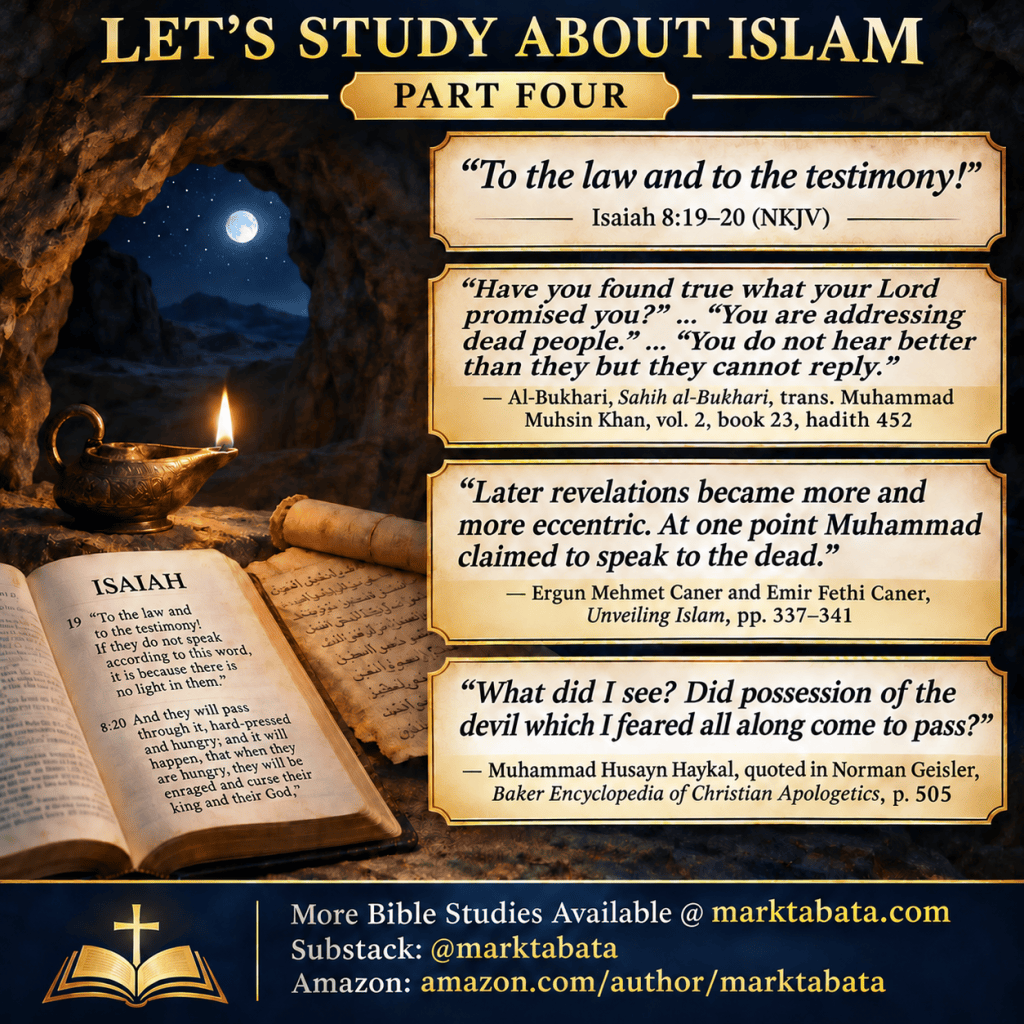
Isaiah 8:19-20-And when they say to you, “Seek those who are mediums and wizards, who whisper and mutter,” should not a people seek their God? Should they seek the dead on behalf of the living? 20 To the law and to the testimony! If they do not speak according to this word, it is because there is no light in them.
The history of Islam would certainly be incomplete without a discussion of Muhammad began to receive his revelations from Allah, the god of Islam.
As noted in a previous study, paganism was a very real element of the religious makeup and environment of ancient Mecca where Muhammad spent so much of his early life. Pagan practices of that time (just like today) included attempts to contact the spirit world, including efforts to summon the dead. This practice is known as necromancy, and is forbidden by God in the Bible.
Leviticus 19:31-‘Give no regard to mediums and familiar spirits; do not seek after them, to be defiled by them: I am the LORD your God.
Leviticus 20:6-And the person who turns to mediums and familiar spirits, to prostitute himself with them, I will set My face against that person and cut him off from his people.”
1 Chronicles 10:13-So Saul died for his unfaithfulness which he had committed against the LORD, because he did not keep the word of the LORD, and also because he consulted a medium for guidance.” (1 Chronicles 10:13)
According to the Islamic Hadith, Muhammad was well-versed in necromancy (the summoning of the dead). For example, we are told:
“2.452: Narrated Ibn `Umar: The Prophet looked at the people of the well (the well in which the bodies of the pagans killed in the Battle of Badr were thrown) and said, “Have you found true what your Lord promised you?” Somebody said to him, “You are addressing dead people.” He replied, “You do not hear better than they but they cannot reply.” (Al-Bukhari, Muhammad ibn Isma’il. Sahih al-Bukhari, translated by Muhammad Muhsin Khan, vol. 2, book 23 (Funerals), hadith no. 452)
Some former devout Muslims who have become disciples of Christ have written of the dark spiritual powers that Muhammad often conjured, and of his necromantic practices in this regard.
Third, later revelations became more and more eccentric. At one point Muhammad claimed to speak to the dead. Questioned about the incident by his novice disciples, the prophet replied, “[The dead] hear me no less than you do, except that they are unable to answer me.” Muhammad not only claimed to communicate with the dead; he prayed for the dead at the cemetery of Baqi al Gharqad. Muslim scholars do not explain away this phenomenon. Rather, they believe that he was a psychic, endowed with heightened perception and sensitivity. One commentator says that communication between the living and the dead is an “indubitable fact.” (ERGUN MEHMET CANER EMIR FETHI CANER, Unveiling Islam: An Insider’s Look At Muslim Life And Beliefs, 337-341 (Kindle Edition); Grand Rapids, Michigan; Kregel Publications)
Again:
Muhammad was deathly afraid of the source of the revelation, believing at first that he was possessed by an evil spirit, or jinn…Remember that the tortured prophet repeatedly believed himself to be demon possessed…Third, later revelations became more and more eccentric. At one point Muhammad claimed to speak to the dead. Questioned about the incident by his novice disciples, the prophet replied, “[The dead] hear me no less than you do, except that they are unable to answer me. (Ergun Mehmet Caner & Emirr Fethi Caner, Unveiling Islam: An Insider Look At Muslim Life And Belief, 311-377 (Kindle Edition); Grand Rapids, Michigan; Kregel Publications).
This background of Muhammad sets the stage for what happened when he first began to receive his “revelations” from Allah. Geisler (referencing numerous Islamic sources) demonstrates that Muhammad’s encounters with the angel Gabriel (allegedly) took a terrifying turn.
One of the most widely respected modern Muslim biographer, Muhammad Husayn Haykal, speaks vividly of Muhammad’s plaguing fear that he was demon possessed: Stricken with panic, Muhammad arose and asked himself, ‘What did I see? Did possession of the devil which I feared all along come to pass?’ Muhammad looked to his right and his left but saw nothing. For a while he stood there trembling with fear and stricken with awe. He feared the cave might be haunted and that he might run away still unable to explain what he saw. [74, emphasis added]. “Haykal notes that Muhammad had feared demon possession before, but his wife Khadijah talked him out of it. For “as she did on earlier occasions when Muhammad feared possession by the devil, so now stood firm by her husband and devoid of the slightest doubt.” Thus “respectfully, indeed reverently, she said to him, ‘Joy to my cousin! Be firm. By him who dominates Khadijah’s soul I pray and hope that you will be the Prophet of this nation. By God, he will not let you down’” (ibid., 75). Indeed, Haykal’s description of Muhammad’s experience of receiving a “revelation” fits that of other mediums. (Norman Geisler, Baker Encyclopedia Of Christian Apologetics, 505 (Kindle Edition); Grand Rapids, Michigan; Baker Books).
This encounter serves as the origins of the words “Islam” and “Muhammad.” The Arabic word “submit” is “Islam,” and the one who is thereby submitted is called a “Muslim.”
These details make us question from the start the alleged Divine revelations of Allah to Muhammad. In all fairness, the weight of evidence suggests that Islam with birthed in demonic oppression from unclean and wicked spirits. This spiritually questionable origin of Islam serves as the unstable and unreliable foundation of this religion.
Lord, help us to carefully weigh the spirits in all things. Amen.


Leave a Reply