Thursday, November 12 2026
More Bible Studies Available @ http://www.marktabata.com. To Receive Free Bible Studies and updates via email, contact Mark Tabata @ 606-216-1757 (SMS Only) or mailto:markatabata@gmail.com (Email). Follow me on Substack: http://substack.com/@marktabata. Also, please visit my author page: http://amazon.com/author/marktabata
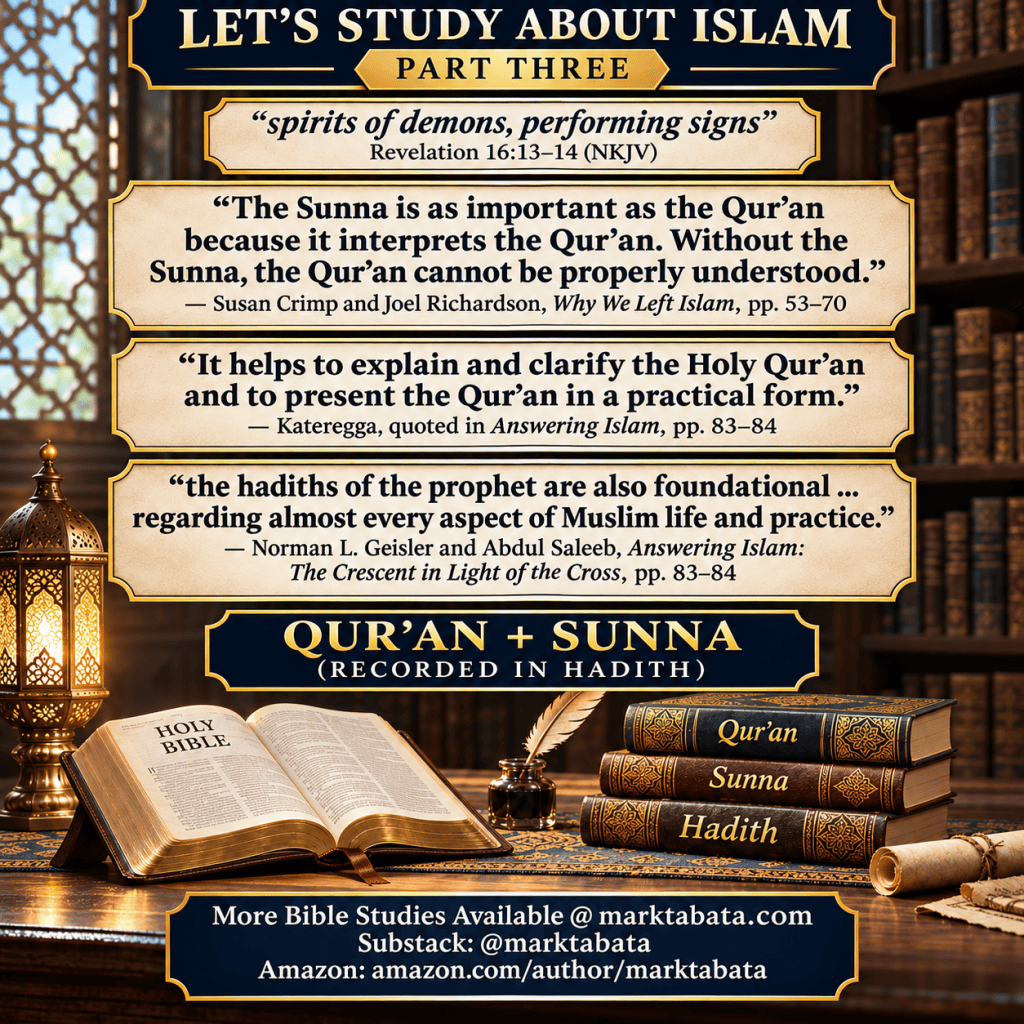
Revelation 16:13-14-And I saw three unclean spirits like frogs coming out of the mouth of the dragon, out of the mouth of the beast, and out of the mouth of the false prophet. 14 For they are spirits of demons, performing signs, which go out to the kings of the earth and of the whole world, to gather them to the battle of that great day of God Almighty.
Around 610, Muhammad claimed that he began to receive revelations from the one true God, who identified himself as “Allah.” It was said that he had received these messages from the archangel, Gabriel. These revelations were later allegedly written down into a book, which is called the Quran (also spelled Koran).
The Quran is broken down into 114 chapters (or, suras) and is about the same size as the standard Christian edition 27 Book New Testament.
In the Islamic religion, the Quran is the absolute authority. It is claimed that this book are the pure unadulterated words of Allah. The next body of alleged authoritative revelation from Allah is found in the Hadith, or the Islamic traditions which (supposedly) recount other events in Muhammad’s life. Together, the Quran and the Hadith form the Sunna, which is said to contain the perfect description of the life of Muhammad.
BEFORE BEGINNING, it is necessary to briefly review some basic facts and terms about Islam and its authority structure. The first and most well-known of Islam’s sacred books is of course the Qur’an. The Qur’an may somewhat be viewed as the Bible of Islam in that it is the primary holy book of Islam. The Qur’an was conveyed entirely by Mohammad, the founder and “Prophet” of Islam. The word “Qur’an” means “recitation” or “reading” in Arabic. The book consists of 114 chapters called surahs. The Qur’an, however, is not the only source of sacred or even inspired traditions in Islam. For while it is the only Islamic text said to be the literal words of Allah, equally important to all Muslims is the Sunna. Much of the Sunna is found in several collections of traditions known as Hadith. Remember that word, as it will be used much throughout this book. “The Sunna” in Arabic literally means, “a clear or well trodden path.” The word refers to whatever Mohammad said, did, condoned, or condemned. It is the record of Mohammad’s sayings, customs, teachings, or the example that he left for all Muslims to follow. Muslims view Mohammad as the perfect example for all human beings. This doctrine is spelled out quite clearly in the Qur’an: If you love Allah, then follow me (Mohammad) Qur’an 3: 31 (Shakir) Whatever Mohammad did or said, therefore, becomes the basis from which to model all life and belief. The Sunna is as important as the Qur’an because it interprets the Qur’an. Without the Sunna, the Qur’an cannot be properly understood. In fact, many aspects and practices of the Islamic religion are not mentioned in the Qur’an but are found only in the Sunna. Therefore, the Qur’an and the Sunna together form the basis for the beliefs and practices of Muslims everywhere. In this sense, both the Qur’an and the Sunna are believed to be inspired and authoritative. When confronted with some of the more violent or base teachings or practices of Islam, most Muslim apologists will simply ask the question, “Where is that in the Qur’an?” This is a purposeful attempt to mislead the questioner. For, as stated above, whether a teaching is found in the Qur’an or only in the Sunna, it is an essential aspect of Islam. (Susan Crimp, Joel Richardson, Why We Left Islam, 53-70 (Kindle Edition): Los Angeles, CA: WND Books, Inc.)
As such, according to Islam, the Hadith are nearly as important in Islamic theology as the Quran.
The reports of Muhammad’s sayings (hadith) and actions (sunnah) were tirelessly collected by subsequent generations. Even though these hadiths were never regarded as equal to the Qur’an, they were viewed as an uninspired record of inspired words and actions. Eventually Muslim theologians of the second and third centuries of the Islamic era, after much examination of the texts (matn) of these hadiths and their chains of narrators (isnads), put it in the book forms that we have today. While among all Muslims the Qur’an is the only sacred and inspired book, nevertheless, the hadiths of the prophet are also foundational because of all the minute details that they provide regarding almost every aspect of Muslim life and practice. Ajijola writes, “(Muhammad’s) life became a source of inspiration to his followers. Even minute acts and deeds of him have been recorded by his companions and contemporaries for the benefit of mankind.” The Muslim author, Kateregga, writes: The Hadith is not a Holy Book (revelation) as the Qur’an and the previous Scriptures. However, to the Muslims the importance of Hadith ranks only second to the Holy Qur’an. The Hadith is complementary to the Qur’an. It helps to explain and clarify the Holy Qur’an and to present the Qur’an in a more practical form.… As Muslims, our knowledge of Islam would be incomplete and shaky if we did not study and follow the Hadith. Similarly an outsider cannot understand Islam if he ignores the Hadith. The greatest Muslim theologian of all time, Al-Ghazali (d. a.d. 1111), in his classical Ihya ulum ad-din (Revival of Religious Sciences), explained the importance of observing the prophet’s tradition in this way: Know that the key to happiness is to follow the sunna [Muhammad’s actions] and to imitate the Messenger of God in all his coming and going, his movement and rest, in his way of eating, his attitude, his sleep and his talk.… God has said: “What the messenger has brought—accept it, and what he has prohibited—refrain from it!” (59:7). That means, you have to sit while putting on trousers, and to stand when winding a turban, and to begin with the right foot when putting on shoes. (Norman L. Geisler, Abdul Saleeb, Answering Islam: The Crescent In Light Of The Cross, 83-84 (Logos Edition): Grand Rapids, MI: Baker Books)
The Quran, the Sunna, and the Hadith form the primary basis of our understanding of Islam. In our next study, we will learn how Muhammad first began to receive his “revelations” from Allah.
The grace of the Lord Jesus Christ, and the love of God, and the communion of the Holy Spirit, be with you all. Amen.


Leave a Reply